For males who had gone/going through the national service in Singapore would most probably know this famous quote by their enciks " Take care of your equipment , and your equipment will take care of you . "
During the briefing session that Small-Time went last week to prepare for his upcoming reservist . The encik ( Regimental Sargent Major ) strongly emphasized on the preparation of FBO ( Full Battle Order ) .
This is how a FBO looks like
Why is it so important to be in FBO during your combat mission/training ?
Imagine yourself in a field camp without the proper items that were supposed to be in the field bag such as the extra uniforms . Are you going to wear the same attire where training drills and on-going mission with dirt , sweat and perhaps blood for the whole week of field camp ? Talk about wear and tear , Talk about health where you can easily fall sick if you do not take care of your personal hygience.
Imagine yourself contacted by the enemy forces ? You engaged the enemy forces but found out nothing came out from your rifle though it's loaded with bullets. The enemy forces would be smiling and gunning their way towards you . Best is you without your helmet . High chance of Headshot ! Have you do a proper weapon check drill ? Are you well-equipped ?
The quote by encik definitely is there for such reasons.
Small-Time would too like to end with a quote " Take care of your financial , and your financial will take care of you . "
Tuesday, 18 March 2014
Sunday, 16 February 2014
Is best really the best ?
As an avid reader on articles written by Senior Correspondent Goh Eng Yeow , today section on small change was on " In Investing , stick to the best companies ."
Mr Goh Eng Yeow cited in any successful investment strategy , the key rules are buy into only the best companies and stick to business sectors which enjoy predictable earnings and higher than average growth , and pay a fair price for the investment .
He gave an example on CNBC Jimmy Cramer who enthralled with Florida orange grower which he knew next to nothing about the business , bought 10 shares of it , made a loss due to frost hit that wipe out the crops .Cutting his loss , he invested into another clothing firm which further halved his capital when the company reported a set of poor earnings.
Jimmy Cramer reflected and came to conclusion that he does not know much about the business which he invested . This perhaps struck it off as chasing the " best sexy hot " stocks for immediate gains and helping the brokers with their commission income effortlessly .
To summarise , the quality of earnings growth over long term will determine the company's fortune , not the quarterly profit figures that send analysts high nine . Some of the best investment ideas may came from observing the habits of consumer , or things near round you . ( This maybe something we tend to overlook when we focus on things too much that we do not know and forget about things we knew) .
Best is rather subjective on individual aspect , as different investors valuate differently.
More importantly is ....
Mr Goh Eng Yeow cited in any successful investment strategy , the key rules are buy into only the best companies and stick to business sectors which enjoy predictable earnings and higher than average growth , and pay a fair price for the investment .
He gave an example on CNBC Jimmy Cramer who enthralled with Florida orange grower which he knew next to nothing about the business , bought 10 shares of it , made a loss due to frost hit that wipe out the crops .Cutting his loss , he invested into another clothing firm which further halved his capital when the company reported a set of poor earnings.
Jimmy Cramer reflected and came to conclusion that he does not know much about the business which he invested . This perhaps struck it off as chasing the " best sexy hot " stocks for immediate gains and helping the brokers with their commission income effortlessly .
To summarise , the quality of earnings growth over long term will determine the company's fortune , not the quarterly profit figures that send analysts high nine . Some of the best investment ideas may came from observing the habits of consumer , or things near round you . ( This maybe something we tend to overlook when we focus on things too much that we do not know and forget about things we knew) .
Best is rather subjective on individual aspect , as different investors valuate differently.
More importantly is ....
Friday, 24 January 2014
Survival of S$5 per day in Singapore
How is it like if you were jobless and had to survive on S$5 or less per day for at least a month ?
What is the value of living S$5 per day in Singapore ?
Let me share with you an article on MoneySmart by a foreign expat " Steve " with his experience .
"With inflation continuing to rise along with the cost of housing and private transportation, there are genuine concerns about the affordability of life in Singapore now and in the future. While some of us might think that expatriates coming to Singapore to work have an easy life, one of our readers has experienced otherwise. He kindly shared his story with us:
After reading Yahoo! Entertainment’s article a few weeks ago about being able to survive on $5 a day for food and transport, I couldn’t help but share my own $5 a day experience. While I applaud Bobby Tonelli and Rosalyn Lee for going through the experience for a day, I don’t think their experience even comes close to showing what 105,000 low-income Singapore families have to go through.
I’m not saying that I do either. Only those who live like that on a day-to-day basis really know what it’s like. But I can truthfully say (from the unlikely perspective of an “FT”) that I at least have a much better idea of what they go through after living on $5 a day for a month and a half.
I’ll also admit that I suck at foreign languages. I took 4 years of Spanish in High School and another year at university and I barely managed to squeak by with a passing grade each time. So finding out that most Singaporeans spoke English was enough to convince me to move there. At least I would be able to spare locals the indignity of butchering their native tongue with my hopeless language skills.
After buying my ticket, scrounging up my savings (about $1,200 US dollars), receiving my EPEC, and booking a hostel, I was all set to go!
And when I finally passed through customs, I was wearing an old pair of cargo shorts and a Green Day t-shirt. And the only thing accompanying me was a damn ugly secondhand suitcase I purchased from a pawn shop the week before.
After changing money and taking a cab, I finally arrived at the hostel I booked online the month prior. At $18 a day for a 6-man room, it was the cheapest place I could find. $500 dollars later (for a month’s booking), I was lying on my bed, ignoring the burping Pakistani above me and the horny French couple making out on the bed across from mine.
I was SURE it wouldn’t take more than a month to land a job here…
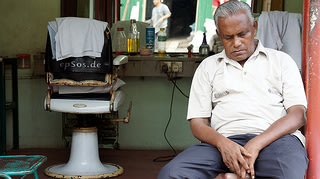
Here was a guy coming from a completely different situation than mine. While I was dealing with a bad economy, he was dealing with a hyper-competitive homeland where top professionals are more or less forced to look elsewhere for employment that pays them more fairly.
While I was acting more like a tourist instead of a serious job-seeker, sending my resume and portfolio to only a few companies in the morning, and sightseeing the rest of the day, he was sending them out nonstop.
After about 3 weeks, that’s when I started to get worried. I had only received one email back and my wallet was getting much lighter. I had completely underestimated how difficult it would be find employment here.
If I could compare my idiocy to anything, it would be to how the British completely underestimated the Imperial Japanese Army during the Battle of Singapore (something I learned from a history-loving cab driver who was kind enough to enlighten me about Singapore history).
The only difference was that my ass was the one getting kicked – by the tough Singapore job market.
By then, I figured that I probably wasn’t going to get a job unless I started being more like Kumar. So I booked another month, leaving me with about $150. I panicked! But Kumar helped me get my act together so I could plan my spending with the money I had left and put my job search into overdrive.
There would be no more food court, fast food, beer, soda, sightseeing, or slacking until I found a job.
But until that happened, my reality turned from tourist/job-seeker, to “Hunger Games” participant. It’s pretty appropriate really, considering I was fighting against hundreds of people for every job posting.
Here’s what I learned from my $5 a day experience:
You never really get used to the stomach pains and constant growling that comes from not getting enough to eat.
I would actually buy bread to snack on if I wanted to quiet my stomach temporarily. If I ate particularly cheap one day, I would get myself a jar of jam or kaya to make snack time more flavorful. Kumar would also offer me some of the snacks he had (even though he was on a tight budget too), but I was too full of pride to accept more than half the time.
One thing is for sure, I was definitely was not getting the 2,000 calories nutritionists recommend for daily health.
I wouldn’t say I was starving, but I was losing weight. By time time my hard efforts finally landed the interview that got me my first job in Singapore, I had gone from about 72kg to 65kg.
I was broke. I was hungry. I was f****d.
My foolish hubris had put me in this situation. And I had to find a way to dig myself out of it. I was too far invested in my job search to turn back now. To borrow a line from my least favorite U.S. President, who got us involved in some unnecessary wars; I had to “stay the course.”
I had no choice but to pawn the only other thing of value besides my laptop, which I needed to continue my job search, my beloved Nikon D90 kit. To a designer, having to part from a high-quality camera is like having to eat your precious pet dog to keep from starving.
I guess I should put this under “suffering” too.
Unfortunately, I still had little money to pay for food after using the $500+ I got for my camera to pay for another month at the hostel. That’s when Kumar handed me $100, refusing to take it back because he felt I needed it more. At that moment, $100 had never meant so much to me in my entire life.
He just did what any decent human being would do – no, what any real friend would do.
Luckily, Kumar had just landed a job with an MNC, but was still living in the hostel while he searched for a room to rent. Even luckier, I managed to land my own job a little less than two weeks later.
When I say that you need support, I’m not just talking about money, I’m also talking about having good friends who can see you through tough situations.
When I look back, several things about living on $5 a day in Singapore become very apparent:
It’s been almost 4 years since I went through the experience. But the lessons I learned from it continue to influence my financial decisions and perspective on life in Singapore, especially when you consider that there’s a world of difference between living on a $5 a day budget and doubling it to $10 (which is my everyday budget).
But the sobering fact remains that while getting a job was all I needed to get out of my situation, there are many people out there who don’t have the choices or opportunities I had. And they’re stuck with $5 a day not for a month and a half like I was, but a lifetime.
Thank you for taking a few minutes to read my story.
What is the value of living S$5 per day in Singapore ?
Let me share with you an article on MoneySmart by a foreign expat " Steve " with his experience .
"With inflation continuing to rise along with the cost of housing and private transportation, there are genuine concerns about the affordability of life in Singapore now and in the future. While some of us might think that expatriates coming to Singapore to work have an easy life, one of our readers has experienced otherwise. He kindly shared his story with us:
First of all, I’d like to thank MoneySmart for giving me the opportunity to have my story told.
After reading Yahoo! Entertainment’s article a few weeks ago about being able to survive on $5 a day for food and transport, I couldn’t help but share my own $5 a day experience. While I applaud Bobby Tonelli and Rosalyn Lee for going through the experience for a day, I don’t think their experience even comes close to showing what 105,000 low-income Singapore families have to go through.
I’m not saying that I do either. Only those who live like that on a day-to-day basis really know what it’s like. But I can truthfully say (from the unlikely perspective of an “FT”) that I at least have a much better idea of what they go through after living on $5 a day for a month and a half.
Before the Arrival
I’ll admit that I was barely surviving as a junior designer with a small agency in California back in 2010. Times were tough, especially after the financial crisis. So yeah, that kinda had something to do with wanting to move overseas. That and my idiotic belief that finding a better job in Asia would be easy.
I’ll also admit that I suck at foreign languages. I took 4 years of Spanish in High School and another year at university and I barely managed to squeak by with a passing grade each time. So finding out that most Singaporeans spoke English was enough to convince me to move there. At least I would be able to spare locals the indignity of butchering their native tongue with my hopeless language skills.
After buying my ticket, scrounging up my savings (about $1,200 US dollars), receiving my EPEC, and booking a hostel, I was all set to go!
Enemy at the Gates
Contrary to popular belief, most “ang moh” foreigners don’t arrive in Singapore on First Class, walking through the terminal wearing an Armani suit with an SIA stewardess in each arm. Not me anyway. I arrived on a packed China Eastern Airlines flight that had so much turbulence, I was actually praying that it wouldn’t crash.
And when I finally passed through customs, I was wearing an old pair of cargo shorts and a Green Day t-shirt. And the only thing accompanying me was a damn ugly secondhand suitcase I purchased from a pawn shop the week before.
After changing money and taking a cab, I finally arrived at the hostel I booked online the month prior. At $18 a day for a 6-man room, it was the cheapest place I could find. $500 dollars later (for a month’s booking), I was lying on my bed, ignoring the burping Pakistani above me and the horny French couple making out on the bed across from mine.
I was SURE it wouldn’t take more than a month to land a job here…
Well hey, at least sleeping is free.
Idiocy Kills
As the days went by, I got to know the people around me. Many were Filipinos looking for work just like me, but most of them ended up leaving within two-weeks empty-handed. I struck up a friendship with an Indian national named “Kumar,” who slept on the top bunk opposite mine.
Here was a guy coming from a completely different situation than mine. While I was dealing with a bad economy, he was dealing with a hyper-competitive homeland where top professionals are more or less forced to look elsewhere for employment that pays them more fairly.
While I was acting more like a tourist instead of a serious job-seeker, sending my resume and portfolio to only a few companies in the morning, and sightseeing the rest of the day, he was sending them out nonstop.
After about 3 weeks, that’s when I started to get worried. I had only received one email back and my wallet was getting much lighter. I had completely underestimated how difficult it would be find employment here.
If I could compare my idiocy to anything, it would be to how the British completely underestimated the Imperial Japanese Army during the Battle of Singapore (something I learned from a history-loving cab driver who was kind enough to enlighten me about Singapore history).
The only difference was that my ass was the one getting kicked – by the tough Singapore job market.
By then, I figured that I probably wasn’t going to get a job unless I started being more like Kumar. So I booked another month, leaving me with about $150. I panicked! But Kumar helped me get my act together so I could plan my spending with the money I had left and put my job search into overdrive.
There would be no more food court, fast food, beer, soda, sightseeing, or slacking until I found a job.
But until that happened, my reality turned from tourist/job-seeker, to “Hunger Games” participant. It’s pretty appropriate really, considering I was fighting against hundreds of people for every job posting.
Here’s what I learned from my $5 a day experience:
1. You Will Suffer
At the time, I was a young, 25-year old in good shape. But making the switch from a lifetime of eating 2 or 3 meals a day to one meal a day at the Indian vegetarian stall downstairs ($2.50-$4.50) was pretty traumatic.
You never really get used to the stomach pains and constant growling that comes from not getting enough to eat.
I would actually buy bread to snack on if I wanted to quiet my stomach temporarily. If I ate particularly cheap one day, I would get myself a jar of jam or kaya to make snack time more flavorful. Kumar would also offer me some of the snacks he had (even though he was on a tight budget too), but I was too full of pride to accept more than half the time.
One thing is for sure, I was definitely was not getting the 2,000 calories nutritionists recommend for daily health.
I wouldn’t say I was starving, but I was losing weight. By time time my hard efforts finally landed the interview that got me my first job in Singapore, I had gone from about 72kg to 65kg.
2. You Will Need Support
That $150 dollars I had leftover barely lasted me the month. But by then I still had not landed a job, even though I was diligently searching for one.
I was broke. I was hungry. I was f****d.
My foolish hubris had put me in this situation. And I had to find a way to dig myself out of it. I was too far invested in my job search to turn back now. To borrow a line from my least favorite U.S. President, who got us involved in some unnecessary wars; I had to “stay the course.”
I had no choice but to pawn the only other thing of value besides my laptop, which I needed to continue my job search, my beloved Nikon D90 kit. To a designer, having to part from a high-quality camera is like having to eat your precious pet dog to keep from starving.
I guess I should put this under “suffering” too.
Unfortunately, I still had little money to pay for food after using the $500+ I got for my camera to pay for another month at the hostel. That’s when Kumar handed me $100, refusing to take it back because he felt I needed it more. At that moment, $100 had never meant so much to me in my entire life.
He just did what any decent human being would do – no, what any real friend would do.
Luckily, Kumar had just landed a job with an MNC, but was still living in the hostel while he searched for a room to rent. Even luckier, I managed to land my own job a little less than two weeks later.
When I say that you need support, I’m not just talking about money, I’m also talking about having good friends who can see you through tough situations.
3. You Will Change Your Perspective
My perspective on what needy individuals in Singapore have to endure is different from most because I wasn’t playing a $5 a day “game” that trivializes the experience. I actually went through it long enough to experience the real pain that comes with living at the “poverty” level.When I look back, several things about living on $5 a day in Singapore become very apparent:
- The Cost of Living is Ridiculously High: If you’re living at the “poverty” level, your daily expenses are already so tight that any small rise in the cost of food, housing, or transportation will have major consequences on your finances.
- Everyday Purchases Become Luxuries: Many of the purchases you make on a daily basis such as that cup of Starbucks, Big Mac combo, potato chips, bubble tea, or even a $1.00 can of Coke become luxuries that you cannot afford.
- Your Food Choices are Limited: Fish and meat go from being daily meals to only being served on “special” occasions. Rice, bread, and noodles make up 90% of your diet and price becomes the major determining factor in choosing what to buy.
- Your Clothing Choices are Limited: Branded clothing becomes a thing of the past. Even plain, mid-tier brands are out of budget. You either have to rely on used clothing purchased from Salvation Army or on low- to mid-quality clothing from Geylang or Bugis Street.
It’s been almost 4 years since I went through the experience. But the lessons I learned from it continue to influence my financial decisions and perspective on life in Singapore, especially when you consider that there’s a world of difference between living on a $5 a day budget and doubling it to $10 (which is my everyday budget).
But the sobering fact remains that while getting a job was all I needed to get out of my situation, there are many people out there who don’t have the choices or opportunities I had. And they’re stuck with $5 a day not for a month and a half like I was, but a lifetime.
Thank you for taking a few minutes to read my story.
-Steve "
Subscribe to:
Posts (Atom)